Why traditional SEO metrics fall short in AI Search
For the past decade, digital performance has been measured in traffic, rankings and conversions.
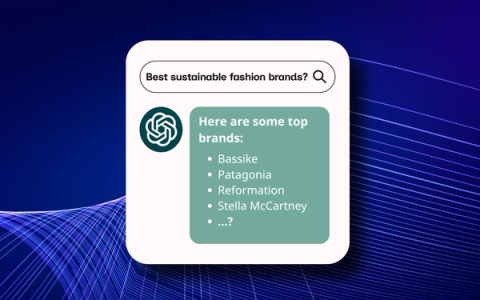
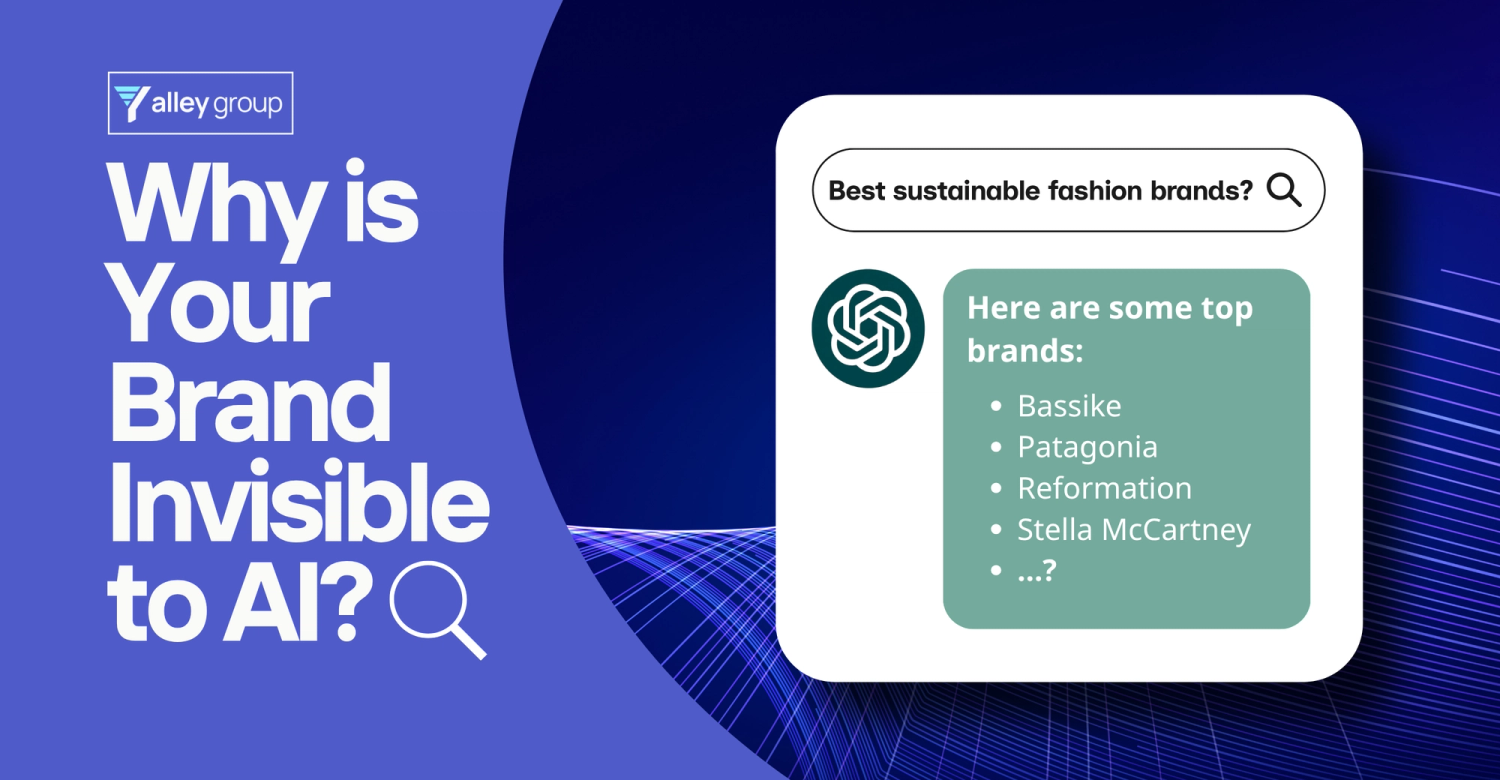
AI has completely upended that model. Increasingly, clients are asking:
“How often do we appear in ChatGPT, Gemini, or AI Overviews?”
It’s a fair question, but the way most marketers try to answer it is flawed.
Tracking AI referral traffic or monitoring a handful of prompts only scratches the surface. To truly understand AI visibility, we need to think beyond clicks and examine structural brand authority across the web.
To illustrate how this works in practice, we analysed HC Rank data from the Common Crawl WebGraph across several global automotive brands. Our research reveals how structural authority differs from traditional link-based metrics, and why it matters for AI search visibility.
AI is an awareness channel, not a click channel
Right now, the most common way brands attempt to measure AI performance is by tracking referral traffic from ChatGPT, Gemini, or other generative engines.
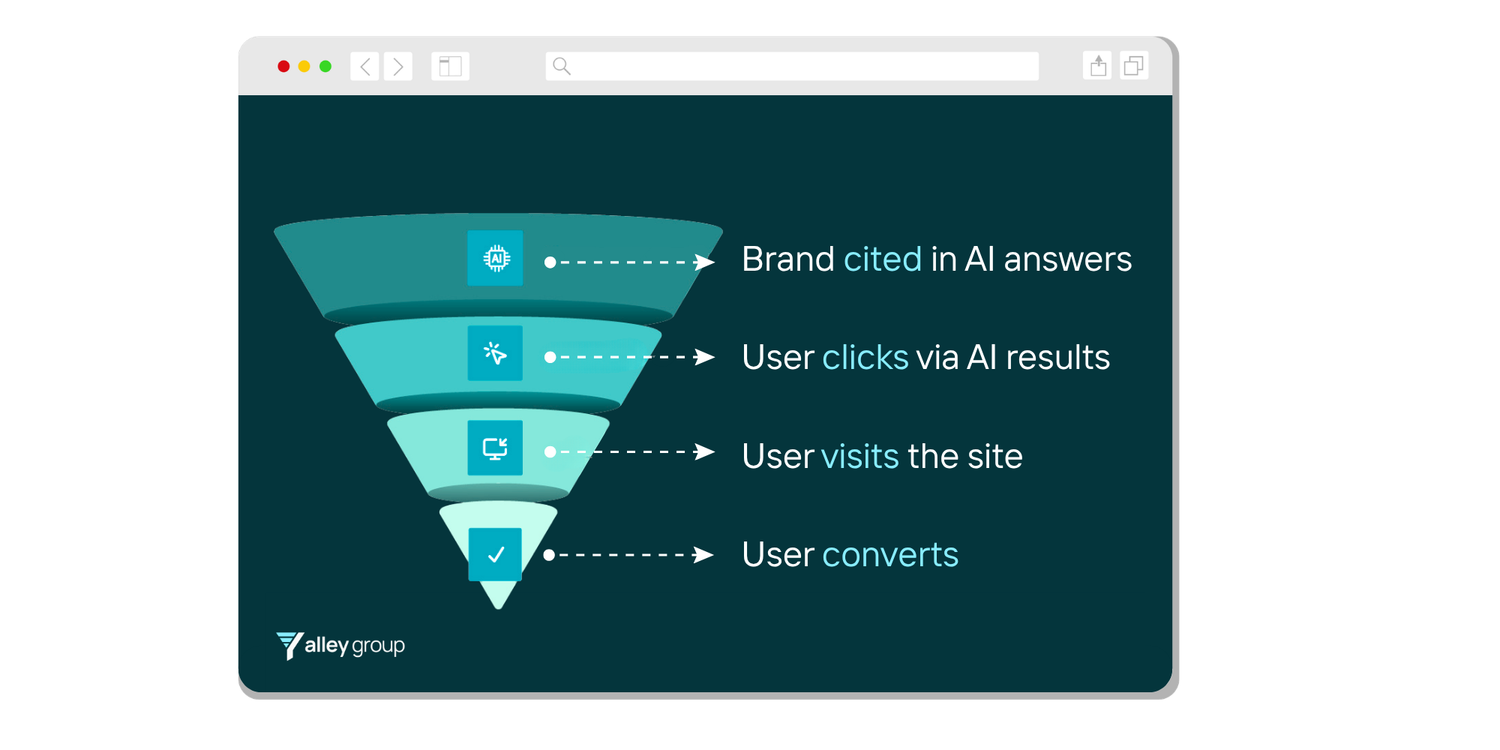
But this approach misses the point entirely: AI engines often don’t send traffic. They synthesise information, provide consolidated answers, and build brand awareness directly in the interface.
A user might see your brand mentioned in an AI response and later:
- Search for you separately
- Visit your site directly
- Book a meeting or take action as part of an AI-driven prompt
- Or simply remember your name
Your referral traffic won’t capture any of that. It also won’t tell you:
- How often does your brand appear?
- In what context does it appear?
- Are you positioned as a leader or an alternative?
- Are you even appearing at all?
Unlike traditional search rankings, AI outputs are non-deterministic: the same prompt can generate different answers. Monitoring a fixed set of tracked questions – as we do with SEO keywords – only tells part of the story.


What is AI visibility & how does it differ from SEO?
SEO focuses on ranking pages in search engines. AI visibility is different. It’s about how likely an AI system is to reference your brand when generating an answer.
That likelihood is influenced by broader signals, including:
- Your domain’s authority across the web
- How consistently and positively your brand is referenced
- Whether your brand appears in trusted, high-quality sources
- The clarity and structure of your content
In short, AI visibility is less about ranking a page and more about reinforcing a brand.
Together, these factors form the foundation of an AI search strategy and guide your generative engine optimisation approach.
The overlooked layer: structural authority
Large language models are trained on massive datasets of web content. One of the most-used open datasets is the Common Crawl WebGraph.
Within this dataset, domain-level authority is measured using two complementary signals:
- PageRank (PR Rank) – a traditional metric based on the quality and quantity of links pointing to a domain.
- Harmonic Centrality (HC Rank) – a measure of how centrally positioned and well-referenced a domain is within the broader web.
While PageRank is familiar to most SEO professionals, Harmonic Centrality is less widely discussed – yet increasingly relevant to AI discoverability.
Harmonic Centrality, explained simply
Harmonic Centrality measures how embedded a domain is within the web’s overall link structure.
Put simply:
- Domains that sit closer to the “core” of the web are more interconnected.
- They are crawled more frequently.
- They appear more consistently across datasets.
Why does this matter? AI models are trained at scale, so brands that are structurally prominent across the web are more likely to be represented in training data.
We’re not suggesting HC Rank is “the ranking factor” for AI systems – citation behaviour is multi-factorial and influenced by freshness, relevance, retrieval systems and platform-specific mechanics. But structural authority appears to be one of the foundational layers shaping which brands AI models are familiar with.
What HC Rank reveals about automotive brands
To see structural authority in action, we pulled HC Rank and PageRank data for ten global automotive brands from the Common Crawl WebGraph Rank Checker Tool.
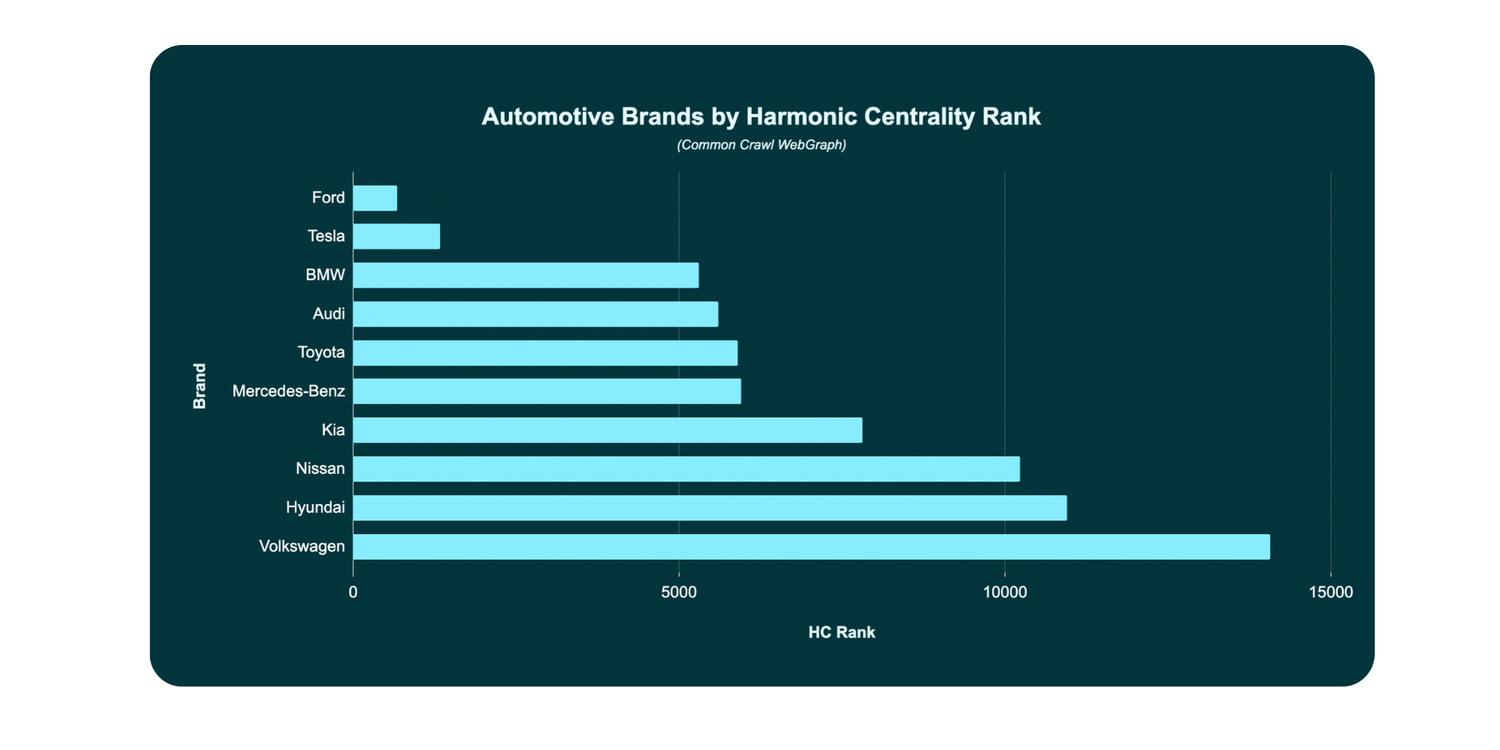
HC Rank comparison (lower = closer to web core)
Looking at HC Rank, Ford and Tesla clearly lead the pack, sitting at #674 and #1,336, respectively. This suggests these brands are well reinforced across authoritative domains and sit closer to the “core” of the web.
On the other end of the spectrum, Volkswagen (#14,069) and Hyundai (#10,954) sit further out in the long tail. That doesn’t necessarily mean their SEO is weak – they may still have strong individual pages – but structurally, they’re less embedded across the web’s network.
The takeaway here is straightforward: being consistently referenced across high-quality sources matters for brand authority in a way that backlinks alone can’t capture.

PageRank vs HC Rank: structural authority vs link equity
Next, we mapped HC Rank against PageRank to see how link equity aligns with structural prominence.

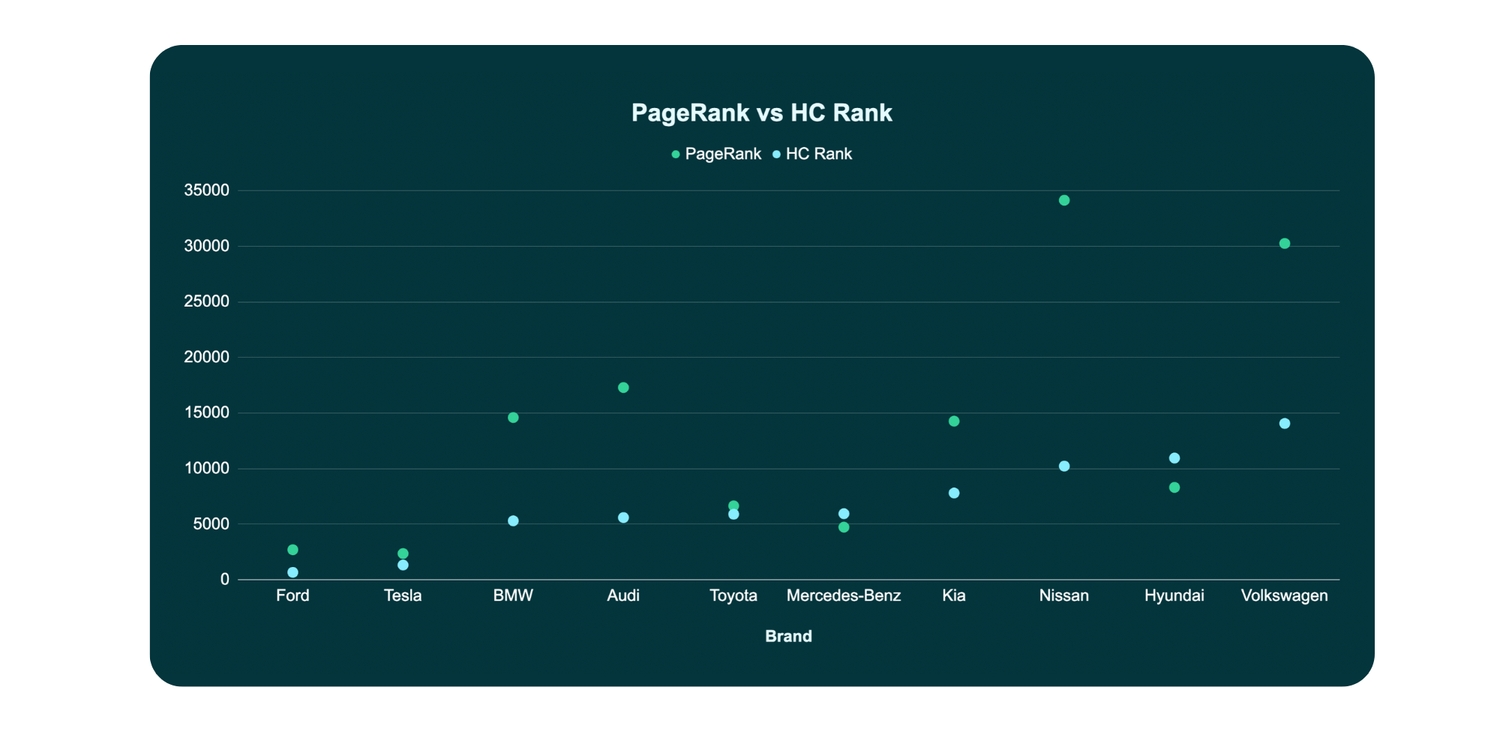
- Tesla and Ford perform strongly across both metrics, reflecting robust backlinks and widespread structural reinforcement.
- BMW and Audi show strong PageRank but comparatively weaker HC Rank. Essentially, they have strong SEO clout but are less consistently reinforced across the web.
- Volkswagen and Nissan rank lower on both metrics, underscoring gaps in both links and structural presence.
What this shows is that structural authority is a distinct layer of brand visibility. Some brands might dominate search rankings, but only those reinforced across the web’s core are more likely to be “seen” by AI systems generating answers.
How to optimise for AI visibility
AI search optimisation isn’t about manipulating a single metric – structural authority is a byproduct of sustained digital presence.
As AI becomes an awareness channel, digital PR and reputation building move from optional to foundational. This is the core of visibility marketing, ensuring your brand is reinforced both on-page and across authoritative sources.
1. Reinforce your brand consistently
Every credible mention across media, partnerships, forums and industry publications contributes to structural authority. Consistency compounds, so make sure to avoid:
- Fragmented naming
- Inconsistent messaging
- Scattered brand references
2. Prioritise genuine reputation building
AI systems detect patterns at scale. Artificial amplification or manipulative link tactics are unlikely to create durable impact. We encourage our clients to focus on:
- Meaningful media coverage
- Thought leadership content
- Industry partnerships
- Credible third-party references
Structural authority reflects real-world reputation, not shortcuts.
3. Monitor authority, not just traffic
As discussed earlier, tracking AI visibility is inherently different from traditional SEO and, as such, demands a much broader lens:
- Direct clicks are insufficient – AI often drives awareness, not immediate visits.
- Prompt monitoring provides snapshots, not systemic insight.
- Authority metrics such as HC Rank offer a scalable proxy for structural presence.
Benchmark your domain against competitors, track authority trends over time, and identify whether gaps are structural rather than keyword-level.
FAQs
How does ChatGPT decide which brands to reference?
Primarily through patterns in training data representation, reinforced by authority signals such as PageRank and Harmonic Centrality. Freshness, relevance and content structure also influence outputs.
How can brands increase visibility in AI-generated answers?
Build authority across credible sources, maintain consistent brand references and invest in sustained digital PR and high-value thought leadership content.
What is AI discoverability and how is it different from SEO?
SEO focuses on ranking pages in search engines. AI discoverability measures how likely your brand is to appear within AI-generated answers, influenced by web-wide authority signals.
How can brands track visibility across AI platforms?
AI SEO tools like CC Rank Checker offer a proxy by measuring HC rank and PageRank. Continuous monitoring and competitor benchmarking help.
Can you measure brand mentions in AI tools like ChatGPT?
Only partially. Prompt-based monitoring provides directional insight, but structural authority metrics and competitive benchmarking offer a more reliable long-term view.
Conclusion
While traditional SEO focused on optimising pages and accumulating backlinks, AI discoverability introduces the question: How embedded is your brand within the web’s core network of authority?
That’s not just a content problem – it’s a structural one.
Metrics like Harmonic Centrality provide a window into that structural layer, helping brands understand how consistently they are reinforced across the web. When combined with traditional SEO metrics, like competitor benchmarking and AI citation monitoring, we get a much clearer picture of how likely a brand is to appear in AI-generated answers.
At Alley, we analyse structural authority alongside search performance to identify gaps that page-level optimisation alone can’t solve.
Want to improve your brand’s AI visibility? Book a chat today to discover how we can strengthen your presence across the web with our Generative Engine Optimisation Services.

Written by
Tahlia Reynolds