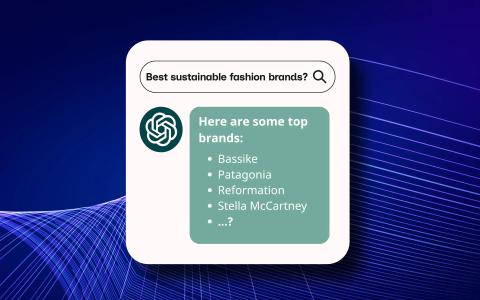
How to boost conversions with chatbot data
Most brands measure their virtual assistant by how many queries it resolves. That sounds reasonable, but it also misses the point.
Instead of asking how well your virtual assistant performs, the smarter question is “why did the customer have to ask in the first place?”
That reframe changes everything.
Every question a customer types into your chatbot is a signal. It means your product page didn't answer that question first. That's not a failure of the assistant. It's a failure of the page. And right now, most brands are collecting that signal, resolving the individual query, and then doing nothing with the pattern underneath it.
That pattern is where the real value lives.
The missed opportunity hiding in plain sight
Research shows that websites equipped with chatbots successfully address around 90% of customer inquiries. By most measures, that's a strong performance.
But what that number doesn't show you is that every one of those resolved queries is a signal that your product page didn't do its job.
The problem runs deeper than most teams realise. Statistics suggest that global eCommerce cart abandonment averages 70.19%, representing $260 billion in recoverable lost orders annually. A significant portion of that abandonment traces back to unanswered questions, not poor intent.
The Baymard Institute also found that hidden or poorly structured product specifications create unanswered questions that lead to eventual product or site abandonment. That means customers aren't leaving because they don't want to buy. They're leaving because the page didn't give them what they needed to feel confident enough to do so.
And yet most brands collect that signal, resolve the query, and move on. The chat log closes. The dashboard sits unopened. The pattern goes unexamined.
This is an organisational problem as much as an analytical one. Virtual assistants are typically owned by customer service or digital experience teams. CRO sits somewhere else entirely. The insight generated by one rarely finds its way to the other, not because nobody values it, but because there's no established workflow to make it happen.
Brands that close that gap have a structural advantage. They're not guessing at what customers need to see. They know, because their customers told them.
Expensive research is no longer the only path to CRO
Brands spend tens of thousands of dollars every year trying to answer a deceptively simple question: what do our customers need to feel confident enough to buy? They commission focus groups, hire CRO consultants, pay for heatmap tools, and bring in conversion specialists to pore over session recordings.
All of that typically starts at five to six figures. The deliverable, after weeks of research, interviews, and analysis, is usually a prioritised list of what customers need to see before they're ready to convert.
Friction points. Unanswered questions. Missing confidence signals.
That is exactly what your virtual assistant query data already contains. Not as a quarterly report. Continuously, at scale, updated in real time, in your customers' own words.
A focus group tells you what a carefully selected panel thinks, weeks after the research was designed. A customer typing into your chatbot at 9 pm on a Tuesday is living the decision in real time. That distinction matters enormously for the reliability of what you learn.
Chat data captures intent, uncertainty, and the exact language customers use when they're trying to make up their minds. And that data has been accumulating in your dashboard the entire time.
The high price of unanswered questions
When you analyse virtual assistant data at scale, patterns emerge quickly. Certain questions appear again and again across thousands of sessions. Those recurring questions aren't random. They're a precise map of where your product pages are creating uncertainty instead of confidence.
And the stakes are real. A recent study revealed that average eCommerce product pages convert at 1.5 to 3%, while top-performing stores achieve 4 to 8%. That’s a 2 to 3x difference that compounds across an entire product catalogue. Much of that gap comes down to whether the page answers the questions customers are actually asking.
The questions your customers ask most frequently are the ones your product pages should already be answering. If they're still asking, the page isn't doing its job, and that gap is costing you conversions.
Stop brainstorming and start listening to your AI data
The fix isn't complicated, but it does require a shift in thinking.
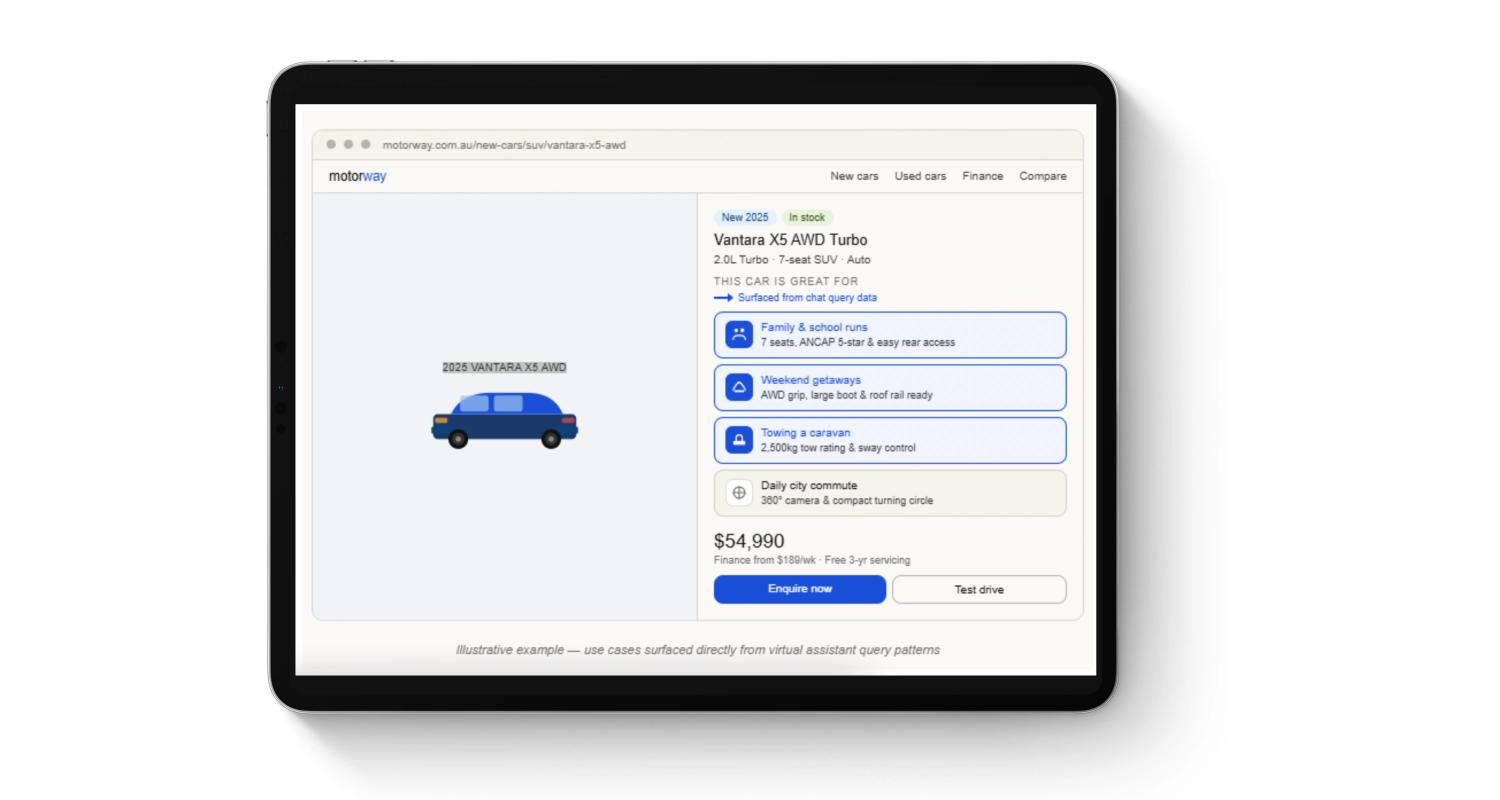
Most teams, when they act on this data at all, simply add answers to pages. That's a start. But the more powerful move is to translate recurring questions into the situations and use cases those questions represent, and surface those directly on the page.
Customers don't think in product attributes. They think in moments from their own lives.
"Will this fit my family?"
"Can I take this off-road?"
"Is this right for a beginner?"
A product page that reflects that framing back, clearly and immediately, removes the need for the question to be asked at all. The use cases on that page didn't come from a marketing brainstorm. They came from the questions real buyers were already asking.
That's the shift: from a page built around what the product has, to a page built around what the buyer is trying to figure out.
It's also worth noting what happens when you get this right. Shoppers complete purchases 47% faster when assisted by AI that offers timely answers and removes friction at the point of decision. Now consider that the same speed gains are achievable on the product page itself, before a customer ever needs to ask a question, if the page already speaks to their situation.
Three ways to start
- Audit your top queries: Pull the 20 most common questions asked across your virtual assistant in the last 90 days and group them by theme. That's your page gap analysis, done in an afternoon rather than a quarter.
- Map those queries to pages: Match each question cluster to the product pages they relate to most. Where volume is highest, the page is doing the least work, and the CRO opportunity is greatest.
- Reframe features as situations: Don't just add answers. Translate recurring questions into the use cases they represent and surface those on the page in the language your customers already use.


Put your real-time customer data to work today
The virtual assistant has been doing its job. Now it's time to let it do yours too.
Chat data is your most underused CRO tool, not because it's hard to access, but because most teams haven't thought to look at it that way yet. The research you've been commissioning at great expense is already sitting in your dashboard, updated in real time, in your customers' own words.
Conclusion
76% of online retailers have either implemented or are planning to integrate chatbots into their customer experience strategies. Most of them are measuring success by query resolution. The ones who shift that lens, who treat every resolved query as a product page brief, will build better pages faster, at a fraction of the cost.
They'll create pages that feel less like catalogues and more like conversations. And conversations convert.
At Alley, we help brands turn performance data into strategy that actually moves the needle. From campaign audits and strategic planning to content optimisation and ad creation, we work with teams who are serious about getting more from what they already have.
If your virtual assistant data is sitting untouched in a dashboard, that's exactly where we come in. Get in touch with us today.

Written by
Nitin Karunakaran