6 Key Takeaways Marketers Should Pay Attention To
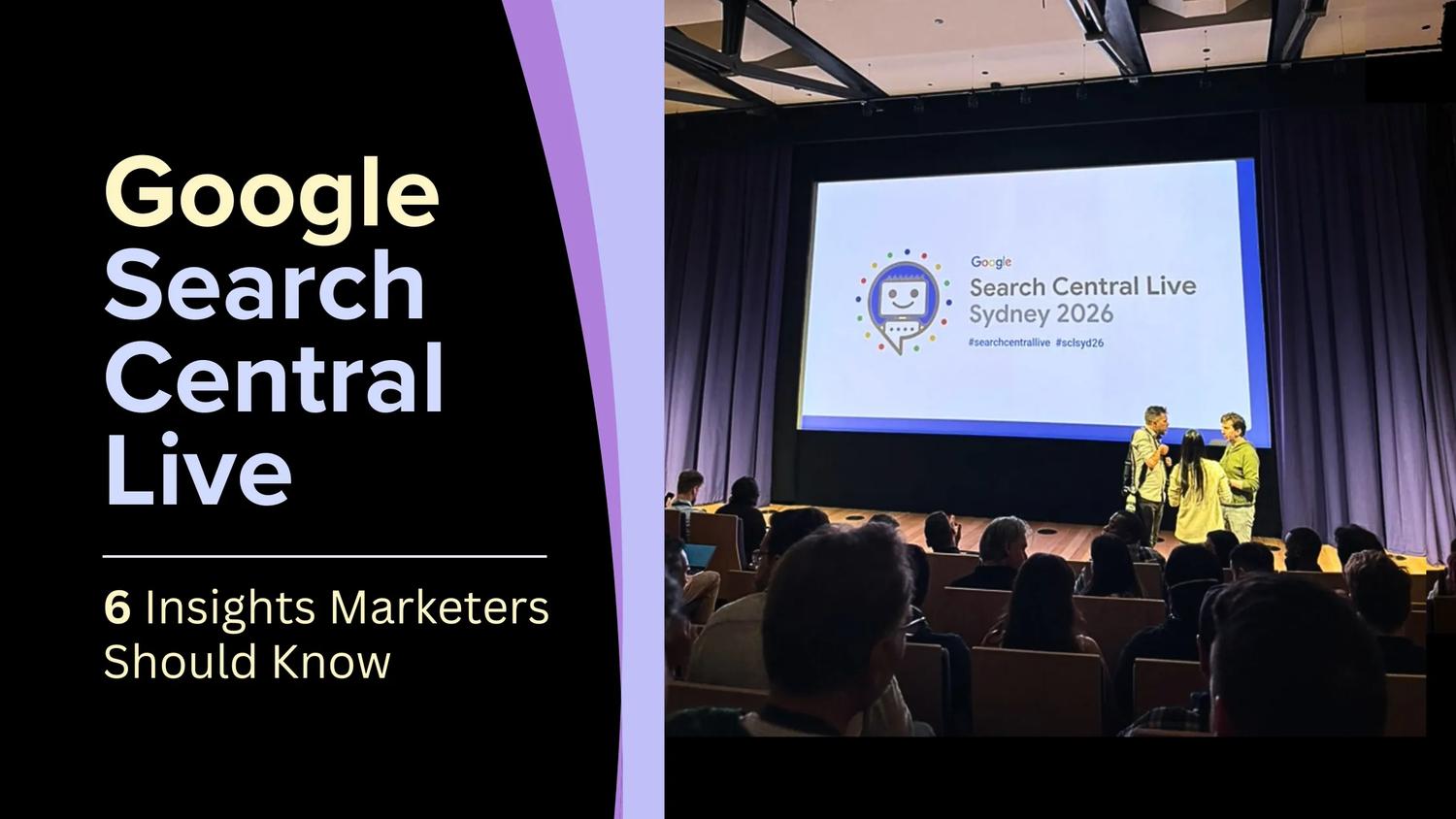
Last week, Alley Group's CTO, Peter and I attended Google's Search Central Live event in Sydney.
Unsurprisingly, AI dominated the conversation. But contrary to much of the commentary surrounding search right now, the biggest takeaway wasn't that SEO is dead or that marketers need to reinvent everything overnight. If anything, Google's message was the opposite.
The fundamentals still matter. The challenge is understanding how they're being applied in an increasingly AI-driven search environment.
Here are the themes we think marketers should actually be paying attention to.
1. Google Isn't Telling Anyone To Reinvent SEO For AI
One of the clearest messages from the day was also one of the most reassuring.
Google repeatedly reinforced that the same systems underpinning traditional search are also powering AI Overviews and other AI-driven search experiences.
That means the fundamentals of SEO remain relevant:
- Creating useful content
- Building trust and authority
- Maintaining strong technical foundations
- Helping users find what they need
Despite the growing number of acronyms entering the market, GEO, AEO and every variation in between, Google's position was refreshingly consistent.
Don't build for AI, build for users. The rest follows.
2. AI Is Changing Search Behaviour More Than Search Fundamentals
The most interesting discussions weren't actually about rankings; they were about behaviour.
Google shared insights showing that AI is making purchase journeys increasingly non-linear, with users becoming more specific in the questions they ask and the information they seek before making decisions.
As AI tools become better at understanding context, people are becoming more comfortable expressing nuanced needs rather than relying on short keyword-based searches.
For marketers, this means understanding intent is becoming even more important. Not because keywords are disappearing, but because user needs are becoming richer and more varied.
3. Traffic May Decrease. Quality May Increase.
One of Peter's standout observations was Google's acknowledgement that traffic patterns are likely to change. The expectation is not necessarily more traffic, but better traffic.
As AI-powered search experiences answer simple questions directly, some clicks will inevitably disappear. But the users who do click through are often further along in their decision-making journey and arrive with stronger intent.
This aligns with what we're increasingly seeing across the industry, where referral traffic from AI platforms often arrives with stronger engagement and conversion signals.
For years, organic search success has often been measured through traffic growth alone. Increasingly, marketers may need to focus on engagement, lead quality and commercial outcomes rather than raw click volume.
Find out more with our blog Why AI Visibility Isn't About Traffic.
4. Australian Search Behaviour is More Different Than You Think
One of the more fascinating presentations focused on Australian consumers.
According to Google, Australians display highly diverse interests compared with markets like the UK and the US. Search patterns across categories such as sport, entertainment and shopping are far less concentrated.
For marketers, this means importing strategies from overseas markets without local validation is becoming increasingly risky.
Understanding your audience, your category and your market becomes even more essential as search journeys become more personalised and dynamic.
Learn more about our Local SEO Services
5. Humans Are Becoming More Important, Not Less
Perhaps the most refreshing theme from the day was Google's emphasis on human expertise.
While AI dominated discussions, there was also strong acknowledgement that AI has limitations.
- Context matters
- Judgement matters
- Creativity matters
Google speakers discussed hallucinations, the inaccurate or fabricated responses that can occur in large language models. While better context can improve outputs, hallucinations remain an inherent limitation of the technology.
This is exactly why human expertise remains a competitive advantage. AI can accelerate research, analysis and content creation, but judgment, creativity and critical thinking are still essential. The brands that use AI most effectively won't be the ones replacing humans, they'll be the ones combining AI efficiency with genuine human insight.
One presentation focused heavily on human-centricity, highlighting the qualities AI still struggles to replicate:
- Empathy
- Creativity
- Lateral thinking
- Lived experience
For brands, this is a useful reminder. AI can help create content faster, but it cannot replace genuine expertise, unique perspectives or authentic brand value.
As more content becomes easier to produce, human insight may become one of the most important differentiators.
6. Technical SEO Isn't Going Anywhere
While AI dominated headlines, technical SEO foundations remained a recurring theme.
Peter noted Google's ongoing emphasis on crawlability and site infrastructure, particularly for enterprise-scale websites. For very large sites, understanding crawl behaviour and analysing Googlebot logs remains essential.
That's hardly revolutionary advice, but that's also the point.
The future of search isn't being built on shortcuts. It's being built on the same foundations that have always supported discoverability.
Conclusion
If there was one overarching takeaway from Search Central Live, it was this:
The search landscape is evolving rapidly, but the principles behind sustainable visibility remain remarkably stable.
AI is changing how people discover information. It's changing how users research products. It's changing how traffic flows across the web. What it isn't doing is making quality, trust, expertise and technical excellence irrelevant.
The brands that will perform best over the next few years are unlikely to be the ones chasing every new AI optimisation tactic. They're more likely to be the ones investing in adaptable digital strategies, strong customer understanding and genuinely useful experiences.
The technology is changing. The fundamentals are not.

Written by
Chloe Zheng